Complexity (Big O)
Overview
Big O notation shows how an algorithm's speed or memory use grows as the input gets bigger.
- Time Complexity: Speed
How the amount of work changes as the input size increases.
- Space Complexity: Memory
How the amount of memory changes as the input size increases.
Measurements:
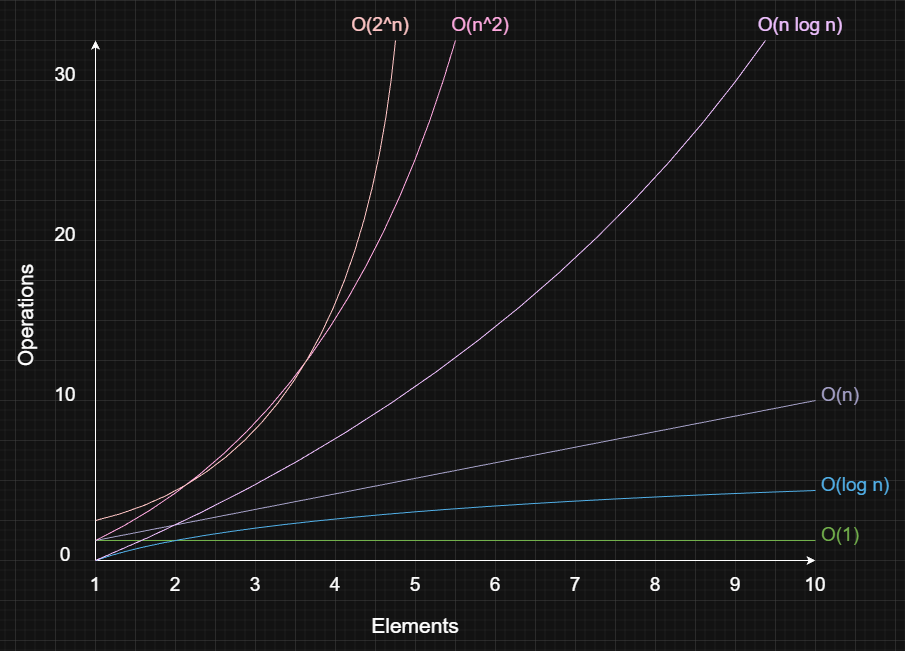
O(1): Constant.The work stays the same no matter how big the input is.
O(log n): Logarithmic.The work shrinks by a large factor each step, often by half.
O(n): Linear.The work grows at the same rate as the input.
O(n log n): Log Linear.The input is split into smaller parts that get handled in about
log nstages with each stage doingO(n)work.O(n^2): Quadratic.The work grows with the square of the input size.
O(2^n): Exponential.The work doubles with each extra input item.
Rules
-
Worst Case.
Big O describes the upper limit of how long an algorithm might take. It looks at the worst possible case so you know the running time will never be worse than that.
-
Remove Constants.
Big O cares about how the work grows, not about fixed numbers. This means constants are removed. For example,
O(5n)becomesO(n). -
Different Inputs, Different Variables.
If an algorithm uses more than one input, each input should have its own variable so the complexity stays clear to accurately capture their separate impacts.
- Sequential loops:
- Same inputs:
O(a + a)->O(2a)->O(n)func(a) { a.loop1 {} a.loop2 {} } - Different inputs:
O(a + b)func(a, b) { a.loop1 {} b.loop2 {} }
- Same inputs:
- Nested loops:
- Same inputs:
O(a * a)->O(a^2)func(a) { a.loop1 { a.loop2 {} } } - Different inputs:
O(a * b)func(a, b) { a.loop1 { b.loop2 {} } }
- Same inputs:
- Sequential loops:
-
Drop the Non-Dominant Terms.
Only the term that grows the fastest is kept. All smaller (non-dominant) terms are removed because they have much less effect as the input grows.
For example,
O(n) + O(n^2)becomesO(n^2).func(a) { a.loop1 {} a.loop2 { a.loop3 {} } }