Linked List
Overview
A linked list is a data structure made of nodes where each node holds a value and a reference to the next node. The nodes form a chain in memory which allows the list to grow or shrink easily by adjusting references.
| Operations | Complexity | Description |
|---|---|---|
| Access/Edit | O(n) | Reaching a position requires sequential node traversal. |
| Access/Edit first & last | O(1) | Head and tail pointers give direct access to ends. |
| Insert | O(n) | Traversal is required to reach the insertion point. |
| Insert front & end | O(1) | Head or tail pointer is updated directly. |
| Remove | O(n) | Traversal is required to locate the node. |
| Remove first | O(1) | Head pointer is updated directly. |
Background
Linked lists can be formed with one or two references per node, creating singly or doubly linked structures.
-
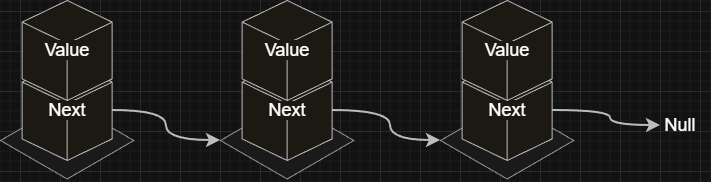
Singly Linked List:
- Value: The data stored in the node.
- Next: A reference to the next node in the list.
-
Doubly Linked List:
- Value: The data stored in the node.
- Next: A reference to the next node in the list.
- Prev: A reference to the previous node in the list.
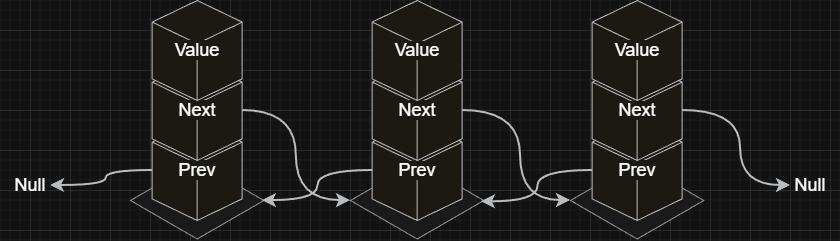
In doubly linked lists, removing the last node is
O(1)because its previous node is directly reachable.
Implementation
class ListNode {
  constructor(value) {
    this.value = value;
    this.next = null;
  }
}

class LinkedList {
  constructor() {
    this.head = null;
    this.tail = null;
    this.size = 0;
  }

  // Access:
  get(index) {
    if (index < 0 || index >= this.size) {
      throw new Error('invalid index');
    }

    let currNode = this.head;
    for (let i = 0; i < index; i++) {
      currNode = currNode.next;
    }

    return currNode;
  }

  // Insert front:
  prepend(value) {
    const newNode = new ListNode(value);

    if (this.head === null) {
      this.head = newNode;
      this.tail = newNode;
    } else {
      newNode.next = this.head;
      this.head = newNode;
    }

    this.size++;
  }

  // Insert end:
  append(value) {
    const newNode = new ListNode(value);

    if (this.head === null) {
      this.head = newNode;
      this.tail = newNode;
    } else {
      this.tail.next = newNode;
      this.tail = newNode;
    }

    this.size++;
  }

  // Insert
  insertAt(index, value) {
    if (index <= 0) {
      this.prepend(value);
    } else if (index >= this.size) {
      this.append(value);
    } else {
      const newNode = new ListNode(value);

      const parent = this.get(index - 1);
      newNode.next = parent.next;
      parent.next = newNode;

      this.size++;
    }
  }

  // Remove:
  deleteAt(index) {
    if (this.head === null) {
      throw new Error('list is empty');
    }

    if (index < 0 || index >= this.size) {
      throw new Error('invalid index');
    }

    if (index === 0) {
      this.head = this.head.next;

      if (this.head === null) {
        this.tail = null;
      }
    } else {
      const parent = this.get(index - 1);
      parent.next = parent.next.next;

      if (index === this.size - 1) {
        this.tail = parent;
      }
    }

    this.size--;
  }

  // (optional) Only to make the list easier to view:
  toArray() {
    const list = [];

    let currNode = this.head;

    while (currNode !== null) {
      list.push(currNode.value);
      currNode = currNode.next;
    }

    return list;
  }
}
Usage:
const myList = new LinkedList();

myList.append('one');
myList.append('two');
myList.append('three');
myList.insertAt(1, 'four');
console.log(myList.toArray()); // (4) ['one', 'four', 'two', 'three']
myList.prepend('five');
myList.deleteAt(2);
console.log(myList.toArray()); // (4) ['five', 'one', 'two', 'three']